kaimb Founders · · Updated
Executive Presence: What It Really Meansand What to Do When You're Told You Lack It
Summary
“She lacks executive presence” might be the most frustrating feedback ever given, because it’s rarely followed by what to actually do about it.
The term sounds like a competency. In practice, it functions as a catch-all for things managers can’t or won’t name specifically: your tone, your posture, your haircut, your assertiveness level, your gender. Research published in HBR confirms the standard has always been fuzzy, and that it has shifted significantly depending on who’s being evaluated.
Here’s what it actually measures, why the feedback usually fails, and what you can do with it anyway.
What “Executive Presence” Actually Means
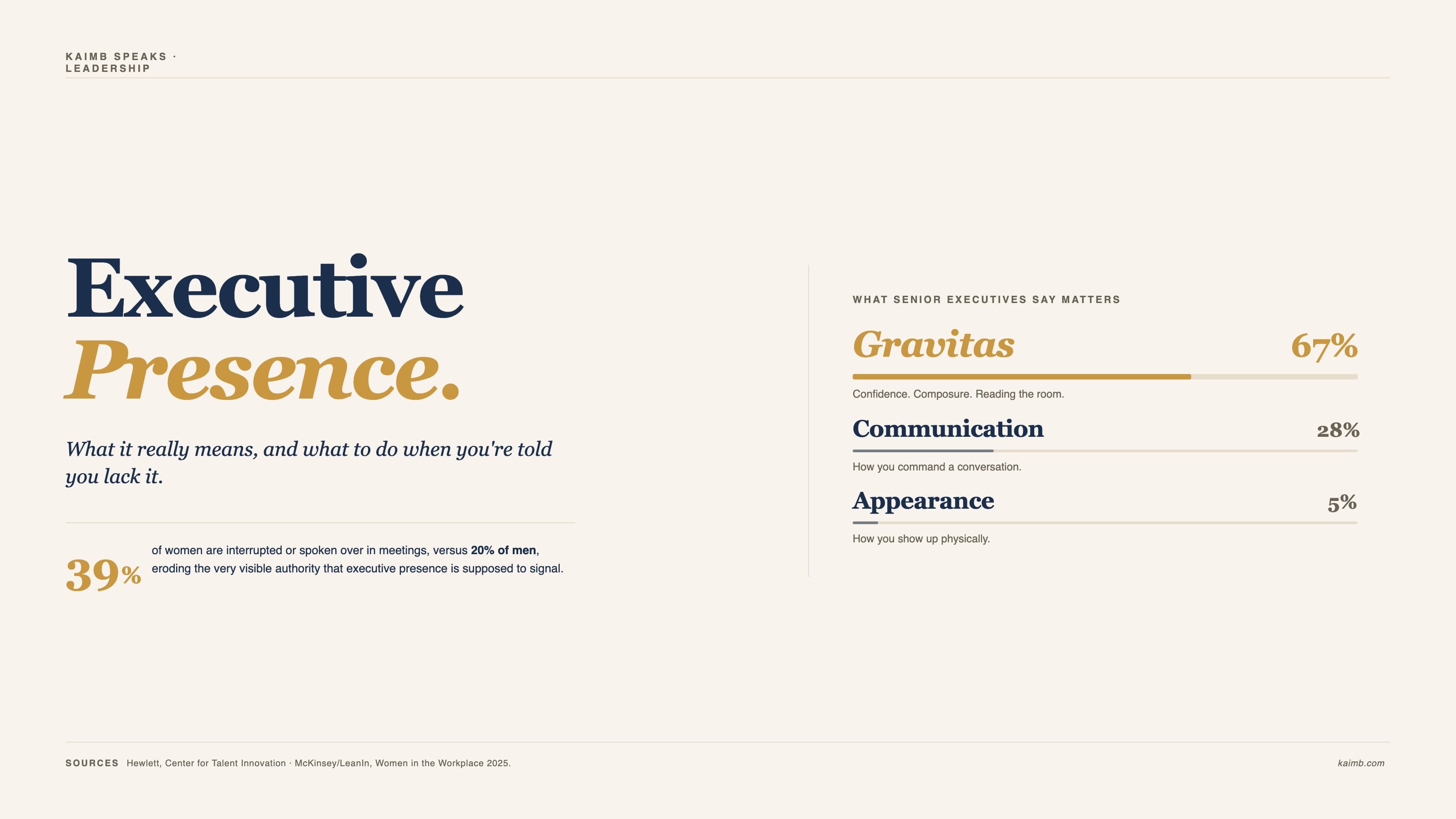
The most widely cited framework comes from researcher Sylvia Ann Hewlett, who surveyed 268 senior executives and found that executive presence breaks into three components: gravitas (how you carry authority), communication (how you command a room), and appearance (how you show up physically). Of those, 67% of executives ranked gravitas as what really matters: specifically, confidence, decisiveness, composure under pressure, and the ability to read a room.
That’s a useful starting point. But it has a problem: gravitas is subjective. And subjective criteria break differently depending on who’s being assessed.
For women, the feedback gets filtered through a double bind that has been well-documented in the research. Lean too much toward confidence and decisiveness, and you’re labeled aggressive or abrasive. Lean toward collaboration and warmth, and you’re told you lack authority. McKinsey’s 2025 Women in the Workplace report found that 39% of women are interrupted or spoken over more than their peers, versus 20% of men, a daily erosion of the exact visible authority that executive presence is supposed to signal.
Why the Feedback Is Often Useless, and What That Costs You
Here’s what makes “lacks executive presence” uniquely damaging: it sounds specific but delivers nothing actionable.
Real listening data from women navigating this feedback captures it precisely: “You need more swagger or gravitas or to own the room. These amorphous phrases are highly subjective and hard to create behavioral change around.” Others described the feedback more bluntly: a lazy shorthand for myriad issues managers can’t or won’t name specifically.
The cost is real. Stanford researchers Correll and Simard analyzed performance reviews across multiple organizations and found that women receive about half as much feedback linked to concrete business outcomes compared to men. When feedback is personality-based and vague, you can’t act on it. You can only internalize it.
Men are not receiving equally vague feedback. When men’s reviews say “develop your communication skills,” they tend to come with specifics: which meetings, which stakeholders, what outcomes to aim for. The same gap applies to executive presence feedback. Granular, actionable developmental direction lands more often with men. Vague, personality-based verdicts land more often with women.
What executive presence looks like for women in India
Only 1% of women in India hold board-level positions, despite 79% aspiring to senior leadership (KPMG and AIMA, Women Leadership in Corporate India, 2026).
The standard explanation is that women lack executive presence. Based on the women we have worked with, it manifests differently.
Here is what we actually see: a woman who had the confidence to pitch and win a major AI mandate for her organisation. She had the decisiveness to drive it through a room full of competing opinions. She had the composure to deliver under pressure and the ability to read every stakeholder in the process. All four pillars, present.
When her CEO asked who had led the project, she introduced herself as someone "working in data."
The work was visible. She was not.
This is the pattern we see repeatedly. She had the skills. What she believed, deeply, was that the work would speak for itself. That good results get noticed. That outcomes are what matter. But share of voice matters in any team. High quality work with low visibility still translates to low executive presence.
She felt she was just doing her job.
Building executive presence in this context is not about learning new skills. It is about making the ones you already have visible. That means ensuring your name is attached to the outcomes you create. It means stating your position in a meeting rather than waiting to see which way things go. It means letting people see the confidence and decisiveness that is already there.
What You Can Do
The goal isn’t to accept the feedback at face value or to dismiss it entirely. It’s to extract the signal from the noise.
Step 1: Translate the verdict into behaviors
When someone says you lack executive presence, ask: “Can you give me a specific example and tell me what you’d recommend I do differently?” The test for real feedback is simple: if it doesn’t tell you what to change, it isn’t feedback. It’s a reaction.
If the person can’t answer, that tells you something important too. The feedback may be about bias or personal preference, not performance. That’s data.
Step 2: Break “gravitas” into its components
Rather than trying to develop presence as an abstraction, work on specific executive presence skills that are observable and measurable:
- Do you state your position before inviting others’ views, or after?
- Do you let silence work for you in meetings, or do you fill it?
- When you’re challenged on something you know well, do you capitulate too quickly?
- Is your name attached to the outcomes your work produces, or does credit land elsewhere?
These are behavioral questions with behavioral answers. They’re where executive presence training should actually start.
Step 3: Audit who is giving you this feedback
One data point is input. A pattern across multiple reviewers and contexts is a signal worth acting on. One manager’s reaction to your style may say more about their expectations than your capabilities. If the same feedback is coming from multiple directions in multiple settings, that’s worth digging into, not as a verdict on your potential, but as a strategic question about how you’re being read, and whether that matters in this context.
Step 4: Get structured clarity on your actual strengths
Vague feedback thrives in the absence of specific data. If you have a clear, evidence-based picture of where your leadership strengths actually sit (not a self-assessment from memory, but a structured competency assessment), you can respond to presence feedback from a position of knowledge rather than anxiety. You know what’s real. You know what to work on. And you know what the feedback is missing.
Step 5: Find an accountability partner
Choose someone who is regularly in your meetings and ask them for specific, targeted observations on the gravitas behaviors you are working on. Not a general impression of how you came across, but focused feedback on exact things: did you hold your position when challenged? Did you open with your view before asking for others? This needs to be someone present in the rooms that matter, not just a mentor who knows you in one-on-one settings.
How kaimb Helps
Executive presence skills are learnable. But the starting point is clarity about what you’re actually working with, not a manager’s vague verdict.
kaimb’s leadership assessment gives women professionals a structured, competency-based picture of their leadership strengths: where they’re genuinely strong, where there are real gaps, and where the feedback they’ve been receiving doesn’t match the evidence. That kind of clarity is what makes executive presence development concrete rather than circular. Start with the assessment. For the broader picture on women in leadership in India, see our hub page.
Frequently Asked Questions
Related reading
Does this resonate with your experience? We welcome your perspective.
Get in touch