kaimb Founders ·
What Is a 360-Degree Leadership Assessment?
Summary
A 360-degree leadership assessment gathers feedback on how you lead from multiple people — typically your manager, peers, and direct reports — and compares it to your own self-rating on the same dimensions. The result is a gap map: where your self-view and others' view align, and where they diverge. That divergence is the signal.
A self-assessment tells you how you see yourself — and that is a useful starting point. But there is a gap between how you intend your leadership and how it actually lands with the people around you. A 360° surfaces that gap. You get the same 8 dimensions scored by the people who experience your leadership every day, placed alongside your own ratings. That comparison is what makes the picture complete.
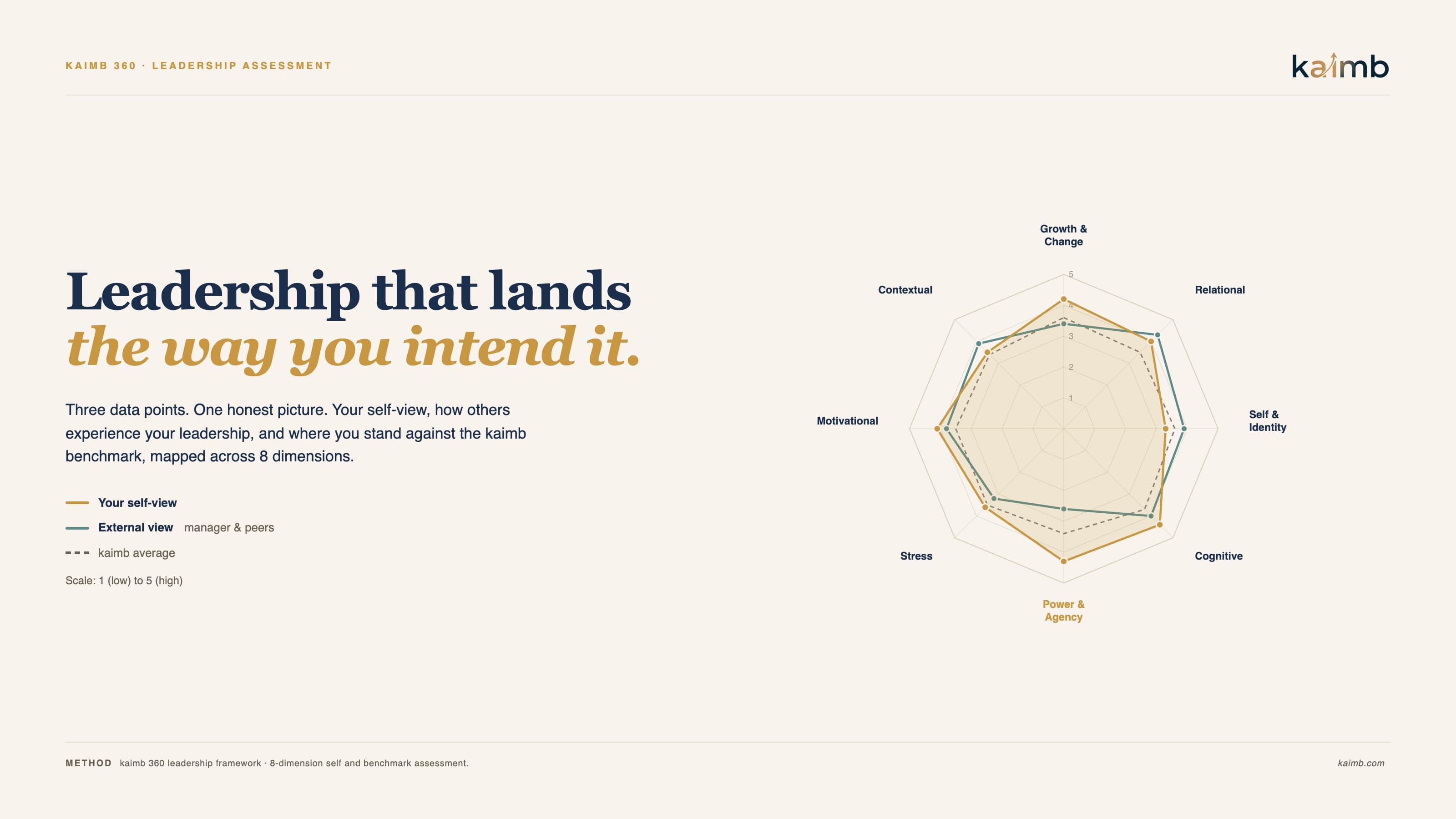
kaimb's 360-degree assessment uses the same 8 dimensions and 39 parameters as the self-assessment, so the frameworks are directly comparable. The report shows three lines on a radar chart: your self-view, the kaimb benchmark (how others who have taken the assessment score), and how your manager and team scored you. kaimb 360° Pro also analyses your presence on external platforms — your LinkedIn profile and resume — so your professional narrative is aligned with what the data reveals about how you lead.
kaimb is for professionals who are willing to put in the work, trust what the data shows, and use it to get somewhere specific — a promotion, an increment, or a role they have been building toward. The combination of self-view, benchmark, external rating, and professional presence is where the real development picture comes from.
What makes a 360-degree assessment different from a self-assessment?
A self-assessment captures how you see your own leadership across 8 dimensions. It is a useful starting point. But it has one structural limit: you can only observe what is visible from where you sit.
The gap between how you intend your leadership and how it actually lands with the people around you is not something a self-assessment collects. A peer might experience your directness as dismissive. Your manager might read careful deliberation as hesitation. These signals exist in the data around you every day.
A 360-degree leadership assessment adds external raters scoring you on the same 8 dimensions. The useful output is not any single number. It is the comparison between your self-view and how others score you on the same criteria. A difference of 1.4 points on Viewpoint Assertiveness between your self-rating and your manager's rating tells you something a self-assessment never could.
For more on what those 8 dimensions measure and what the Lite report shows you, see what a leadership assessment measures.
What does kaimb's 360-degree assessment measure?
kaimb's 360° uses the same 8 dimensions and 39 parameters as the self-assessment. The frameworks do not change between tiers. Your self-view and others' view are scored on a directly comparable scale, so the gap map is precise rather than approximate.
External input can come in several formats. A structured survey sent to your manager, peers, and direct reports gives the cleanest comparison. kaimb also works with what you have: past appraisals, feedback emails, a voice note from a recent conversation with your manager. The format matters less than the perspective.
kaimb 360° Pro extends the picture beyond your organisation. It includes an analysis of your external professional presence — your LinkedIn profile and resume — measured against what the data reveals about how you lead. The question it answers: is what you say about yourself externally consistent with how your leadership actually shows up?
What does the three-line radar chart show you?
kaimb's 360° report centres on a radar chart with three lines, each telling a different part of the story.
Your self-view scores you across all 8 dimensions, the same picture you see in a Lite report.
The kaimb benchmark shows how other professionals in similar roles score on the same dimensions. This is what makes your number interpretable. A 3.2 on Commercial Influence means something different depending on whether the benchmark is 2.8 or 4.1.
Your manager and team's view is the combined rating from people who have experienced your leadership directly, on the same 8 dimensions from the outside.
Three patterns emerge from where those lines sit relative to each other.
Aligned high
Dimensions where both your rating and your raters' rating land above the benchmark. These are your most reliable leadership assets — the strengths to lead with, name explicitly in promotion conversations, and build your case for the next role around.
Self-overestimation
Dimensions you rate higher than your raters do. Where your intended impact is not landing the way you experience it. These tend to be the findings that surprise people most.
Self-underestimation
Dimensions your raters score higher than you do. Strengths you are not claiming or using. These are often the most immediately actionable discoveries — the capability is there, but it is not being deployed or communicated.
Understanding why self-perception and others' view tend to diverge by dimension is covered in the feedback gap.
When is a 360-degree assessment the right next step?
The right starting point is always the Lite self-assessment. It gives you your own picture across 8 dimensions alongside your position relative to the kaimb benchmark. That baseline matters before you bring in external perspectives.
Adding external feedback to an unclear self-picture adds noise, not signal. You need to know what you think about your own leadership before you can usefully interpret what others think.
The 360° becomes the right next step when three conditions are in place. You have a clear read on your development priorities from your Lite report. You are preparing for something specific: a promotion conversation, an increment discussion, a role transition. And you want to test whether how you see yourself matches how the people around you experience your leadership.
The Lite report and the 360° are not alternatives. They are sequential. Each layer adds information the other cannot provide.
How does 360-degree feedback work in Indian organisations?
Senior evaluations in India Inc. rely heavily on informal signals: sponsor relationships, visibility in the right leadership forums, the read a senior leader forms over a year of interactions. Criteria are rarely stated explicitly. Feedback is rarely specific.
"Work on your executive presence" is one of the most common pieces of development feedback. What it actually means is almost never explained.
A 360° converts that vagueness into something you can act on. When the data shows a 1.4-point gap between your own rating and your manager's on Viewpoint Assertiveness, you have something specific to work with. The development action is not "improve your presence." It is "raise your viewpoint clearly in the next QBR to get the alignment you need for the new project."
kaimb's framework is calibrated to Indian corporate contexts — the role expectations, evaluation norms, and leadership pressures that shape how professionals are assessed in India Inc. It is not a US or global benchmark applied without adjustment.
Two ways in:
If you're starting from scratch: kaimb 360° Lite — ₹999, takes 15 minutes. Your self-view across 8 dimensions with the kaimb benchmark. DM founders@kaimb.com for a free access code.
If you have your Lite report and are ready for external perspectives: See 360° Plus and Pro — bring in your manager, peers, and team on the same dimensions, or add the Pro-tier external presence analysis.
Frequently Asked Questions
Related reading
Does this resonate with your experience? We welcome your perspective.
Get in touch