kaimb Founders ·
Leadership Assessment for Women: What It Measures
Summary
A leadership assessment measures the behavioural patterns that shape how you lead: how you think, influence, respond to pressure, and see yourself. kaimb's assessment covers 8 dimensions across 39 parameters. The output is a score on each dimension, a named leadership archetype, and specific development actions.
Most leadership assessments were built for a corporate context that assumes a particular kind of leadership: visible, assertive, unencumbered. They measure against norms not built from women's career patterns in Indian organisations. Scoring average on influence when the environment systematically closes off certain influence channels is a different problem from lacking influence. A tool calibrated to that reality gives different, more useful answers.
kaimb's framework organises the 39 parameters into 8 dimensions: Motivational Drivers, Cognitive Orientation, Growth and Change Orientation, Relational Orientation, Power and Agency Style, Contextual Sensitivity, Stress Response, and Self and Identity. Each captures a distinct layer of how you lead: not what you have achieved, but how you operate.
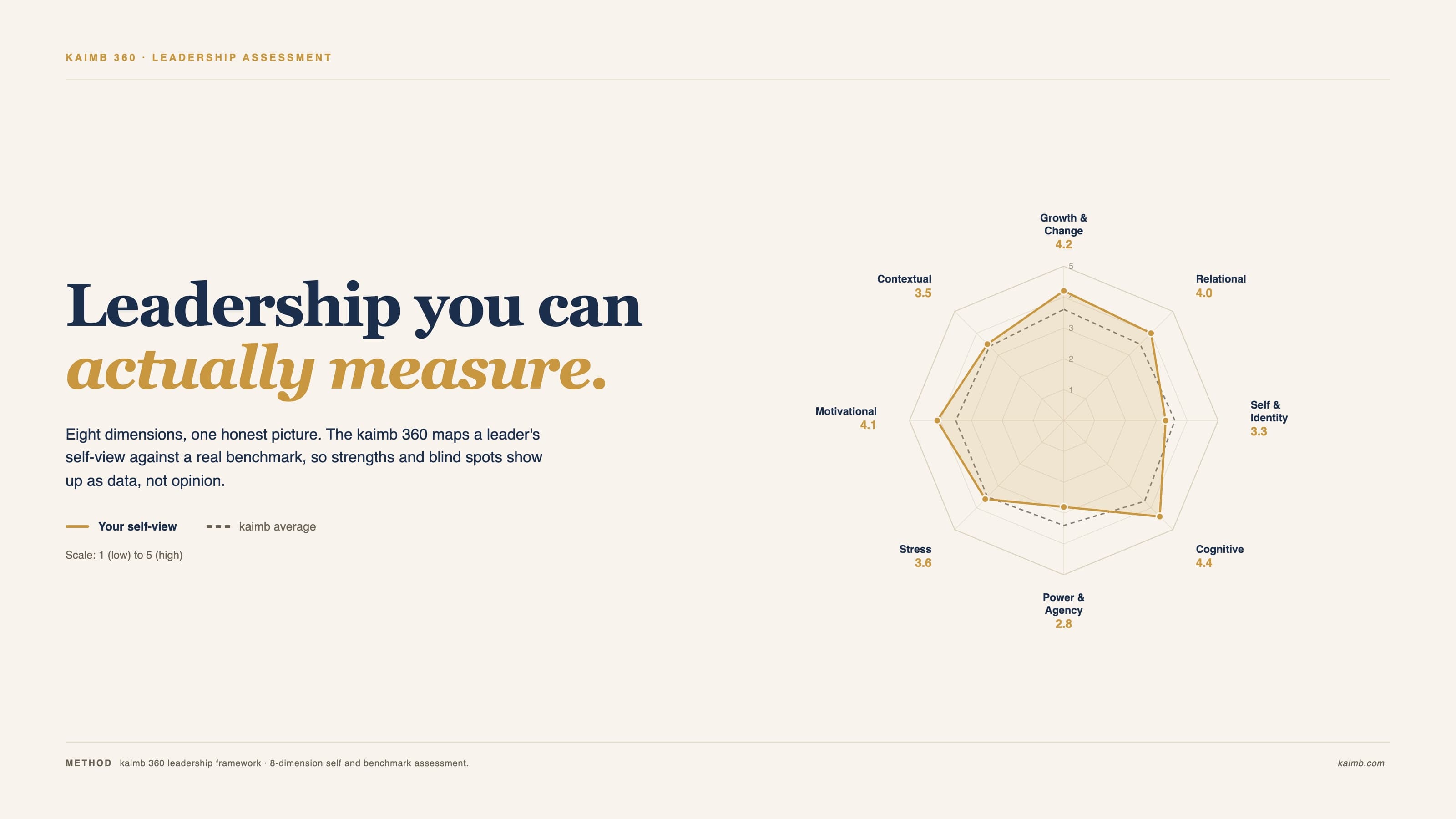
Your report shows a score on each dimension, plotted on a radar chart alongside the kaimb benchmark: how other women who have taken the assessment score. You receive a named leadership archetype, a set of PowerPlays (your high-scoring areas to leverage), PitStops (dimensions most likely to limit your progression), and 3 Action Shifts to work on. The assessment takes 15 minutes.
What do most leadership assessments actually test?
Most assessments in the market today measure personality or strengths: stable characteristics that describe who you are. Tools like DISC, Gallup StrengthsFinder, and 16PF produce a trait profile: the relatively fixed patterns of how you think and behave across all contexts.
Trait-based tools answer "who are you?" That is useful background. It is not, by itself, useful for development, because traits are stable and hard to shift. Knowing you score high on conscientiousness does not tell you what to do differently in your next performance review conversation, or in the room where the promotion decision gets made.
Behavioural assessments ask a different question: how do you lead? They measure patterns of action in specific work contexts: how you influence when authority is informal, how you show up under pressure, how you communicate in rooms where you need to advocate for yourself. Behaviours are learnable. That distinction determines whether an assessment gives you a result to file away or a starting point for real work.
kaimb's leadership assessment measures behaviour across 8 dimensions. That is what the rest of this page covers.
What does a behavioural leadership assessment measure?
kaimb's assessment organises 39 behavioural parameters into 8 dimensions:
- Motivational Drivers: What energises and drives your work choices?
- Cognitive Orientation: How do you think and solve problems?
- Growth and Change Orientation: How do you approach learning and personal evolution?
- Relational Orientation: How do you work with people?
- Power and Agency Style: How do you influence, lead, and take ownership?
- Contextual Sensitivity: How do you read, interpret, and adapt to your environment?
- Stress Response: How do you show up under pressure?
- Self and Identity: How do you see yourself?
The specific parameters within each dimension are not published publicly. What you engage with during the assessment is 39 behavioural self-rating statements and 4 reflective questions. It takes 15 minutes.
The framework was built for Indian corporate contexts. That matters for one practical reason: the benchmark is drawn from other women who have taken the assessment in similar contexts. A score of 2.8 on Power and Agency Style says little in isolation. Against a benchmark built from women in India Inc., it tells you where you stand relative to the pattern associated with progression to senior roles.
The result is a score that is specific, contextual, and comparable. It tells you something a trait profile cannot: where your leadership behaviour sits relative to the women progressing in organisations like yours.
What does your assessment output look like?
The kaimb 360° Lite report has five components.
A named leadership archetype: a plain-language description of your overall leadership pattern, integrating your scores across all 8 dimensions.
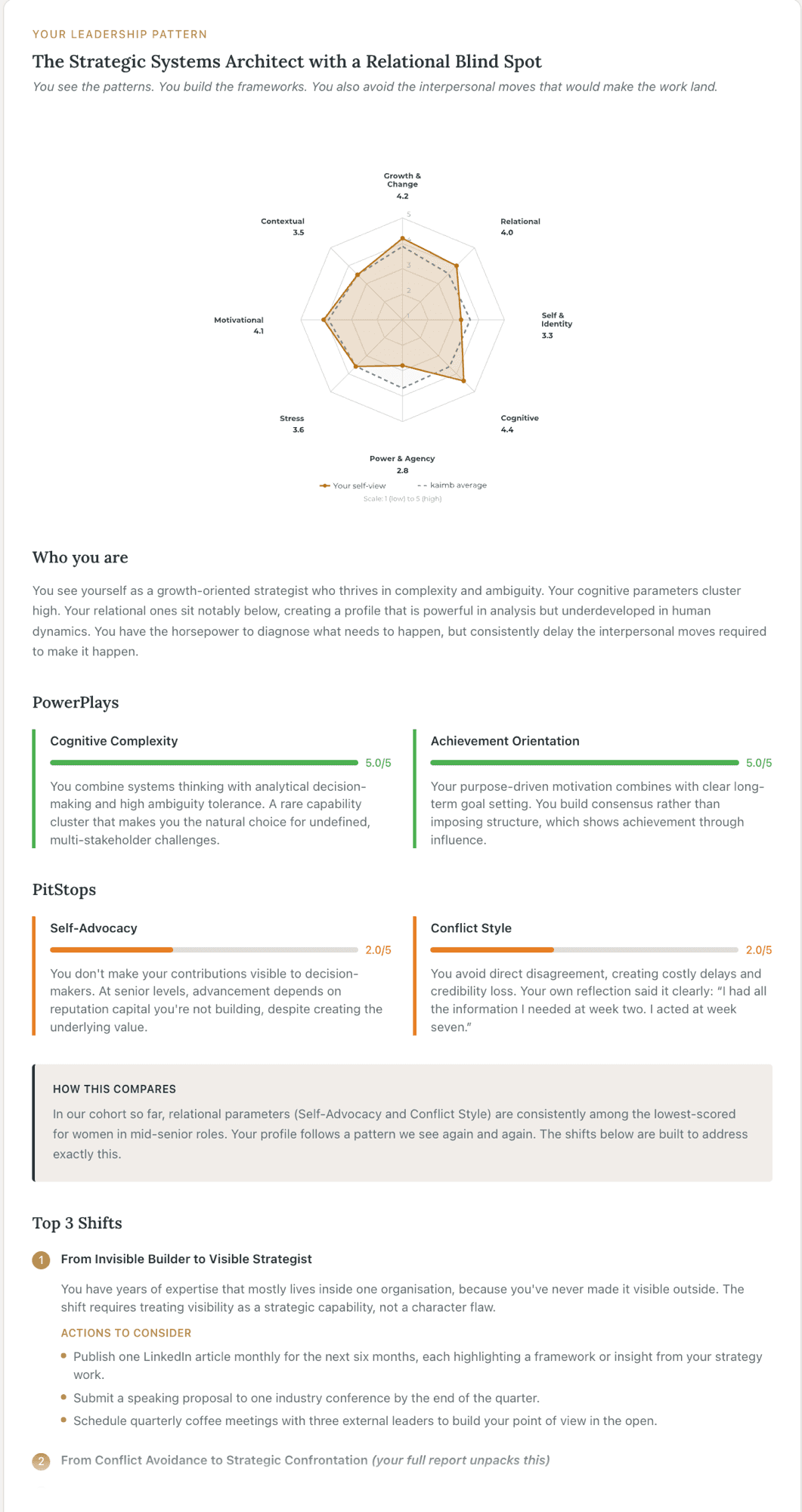
A radar chart: your 8 dimension scores plotted visually, with two lines. One shows your self-view; one shows the kaimb benchmark. The two lines are what make the chart useful. Your score means something because you can see where it sits relative to how other women score.
PowerPlays: your highest-scoring dimensions, with specific guidance on how to use them intentionally. High scores are assets. The assessment tells you how to deploy yours deliberately.
PitStops: the dimensions most likely to limit your progression right now. Each PitStop includes context on why that dimension matters at your career stage, so you know what you are actually working on.
Three Action Shifts: monthly-level actions specific to your profile. These are the concrete starting points, grounded in your scores.
What level of assessment is right for you?
The self-assessment is the foundation. kaimb 360° Lite (₹999, 15 minutes) gives you your self-view across 8 dimensions: scored, benchmarked, with a named archetype and 3 Monday morning Action Shifts. It tells you where you stand and what to work on next.
kaimb 360° Plus (₹4,999, 6 weeks) adds one expert mentoring session and a 6-week structured roadmap. It is for the woman who wants structured support making the shifts the Lite identified.
kaimb 360° Pro (₹9,999, 12 weeks) adds the external layer: manager and team feedback on the same 8 dimensions. The radar chart now shows three lines: your self-view, the kaimb benchmark, and how your manager and team score you. The gap between your self-view and their view is where the most significant development work usually sits. For how to read what those gaps reveal, see the 360-degree leadership assessment guide. Pro also includes LinkedIn and resume branding, 3 mentoring sessions, and a 12-week transformation roadmap.
For the complete comparison, see the kaimb products page.
How is a leadership assessment different from a personality test?
Personality tests like MBTI and the Big Five measure stable traits: introversion, agreeableness, openness to experience. They are a useful map of how you tend to show up. The practical limit is that personality is relatively fixed, and a personality label does not give you a development action.
A leadership assessment measures behavioural patterns that show up specifically in work and leadership contexts. Those patterns are learnable and contextual: they shift with your environment, your role, and the development work you invest in.
The practical difference: an MBTI result might tell you that you prefer structured environments and tend toward introversion. A behavioural leadership assessment tells you that your Power and Agency Style score sits at 2.8/5, specifically on the visibility and ownership parameters, and gives you 3 specific Action Shifts for the next month.
Personality tests answer "who are you?" Leadership assessments answer "how do you lead, and what can you change?"
Can a leadership assessment help with career progression?
An assessment gives you a specific vocabulary for your development. "Work on executive presence" is not a development plan. "Power and Agency Style: 2.8/5, specifically visibility and ownership parameters, with 3 targeted Action Shifts" is.
That specificity matters in three places. In coaching conversations: you arrive with a score and a profile, and the work becomes concrete. In appraisal discussions: the kaimb benchmark shows whether a low score is genuinely low relative to women in similar roles, or just below a standard most people miss. In deciding where to invest time: the PitStops tell you which dimension is most likely to limit your next move.
Assessment alone changes nothing. It gives you a starting point and a clear picture of where you are. The self-awareness gap research documents what most leaders experience: the distance between what they believe about themselves and what the data shows. An assessment closes that gap. The work that follows is on you.
If you have received vague feedback ("be more visible," "work on your presence") and are trying to make sense of it, the Feedback Gap is useful context before you start.
Start with kaimb 360° Lite → (₹999, 15 minutes). Or DM founders@kaimb.com for a free access code.
For the full 360° with manager and team feedback: See all offerings → (360° Plus at ₹4,999 or Pro at ₹9,999).
Frequently Asked Questions
Related reading
Does this resonate with your experience? We welcome your perspective.
Get in touch