kaimb Founders ·
India's Women Lead the World in AI Skills, Not Leadership
Summary
India holds a global ranking almost no one is discussing, and it reframes the entire conversation about women in AI leadership in India. On relative AI skill penetration among women, India sits first in the world.
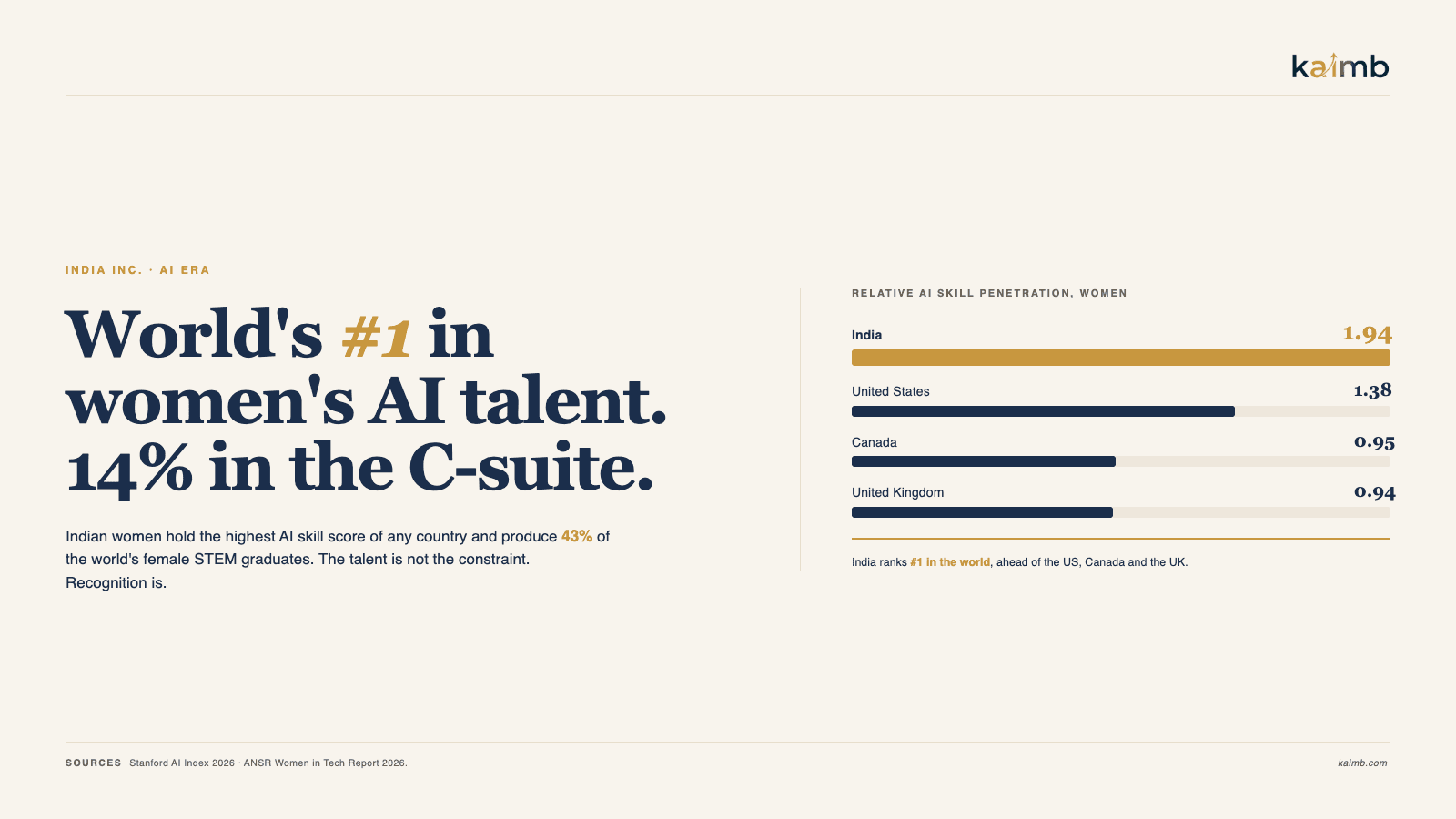
Indian women rank #1 globally in AI skills, scoring 1.94 versus 1.38 in the US, yet they hold just 14% of C-suite seats. The constraint is not talent. India produces 43% of the world's female STEM graduates, and 95% of its women in tech say they are ready to lead the AI era.
Most promotion systems across India Inc. were designed before generative AI existed. They reward seniority, presence, and informal visibility. None of those map cleanly to AI-era leadership. The women most prepared for what is next are being measured against criteria built for what came before.
The talent isn't the constraint. The recognition system is.
Do Indian Women Really Lead the World in AI Skills?
Yes, and the gap is not marginal. On the Stanford AI Index 2026 measure of relative AI skill penetration among women, India scores 1.94, the highest of any country. The United States follows at 1.38, with Canada at 0.95 and the United Kingdom at 0.94. India is not narrowly ahead. It leads the field.
The pipeline behind that number is just as strong. India produces 43% of the world's female STEM graduates, and 95% of Indian women in tech say they are ready to lead the AI era. This is the foundation of women in AI leadership in India: a deep, world-class talent base that is already in place.
If the Talent Is There, Why Are Women Only 14% of India's C-Suite?
The drop happens in the middle, not at the entry point. Women enter India's workforce and technology pipelines in strength, then thin out on the climb to senior leadership. By the C-suite, they hold roughly 14% of seats. This is the same structural pattern documented in the data on India's broken women-leadership pipeline: advancement systems that run on informal visibility rather than demonstrated competency.
The cause is design, not supply. We have written before about why mid-career women disappear before the C-suite. The mechanics are consistent: opaque promotion criteria, informal networks that gate sponsorship, and evaluation systems that reward the leadership signals of a previous era. KPMG and AIMA's 2026 read on women leadership in corporate India points to the same structural friction.
How Does AI Change What Leadership Readiness Looks Like?
AI-era leadership rewards a different set of capabilities: fluency with new tools, judgment about where to apply them, and the ability to lead teams through fast technical change. Indian women are already building these strengths. 69% of Indian women in tech say AI has opened new career pathways for them.
Legacy promotion systems cannot see this. They were calibrated for seniority and presence, not for AI-era competency. So the very women who are most ready for what is next remain invisible to the systems deciding who advances. The skills are real. The infrastructure to name them is missing.
How kaimb Makes AI-Era Leadership Visible
The companies that will lead the next decade are the ones that promote their best AI talent, not just hire it. That talent is already inside most organizations. What is missing is a way to see it clearly.
At kaimb, we build structured, competency-based assessment that names AI-era strengths in the language organizations actually promote on. Instead of relying on informal visibility, leaders get an evidence-based read of where each person is genuinely strong. Cohort diagnostics surface high-potential women before they leave, so the organization recognizes its best AI talent while it still has it.
India's women are already building the skills the AI era rewards. The question is whether your organization has the infrastructure to recognize, develop, and promote them. Start with a kaimb leadership assessment.
Frequently Asked Questions
Related reading
Does this resonate with your experience? We welcome your perspective.
Get in touch