kaimb Founders ·
Women in Leadership in India: What the 2026 Data Actually Shows
Summary
The data on women in leadership in India has sharpened considerably in 2026. The story it tells is not about ambition or capability. It is about where the design breaks.
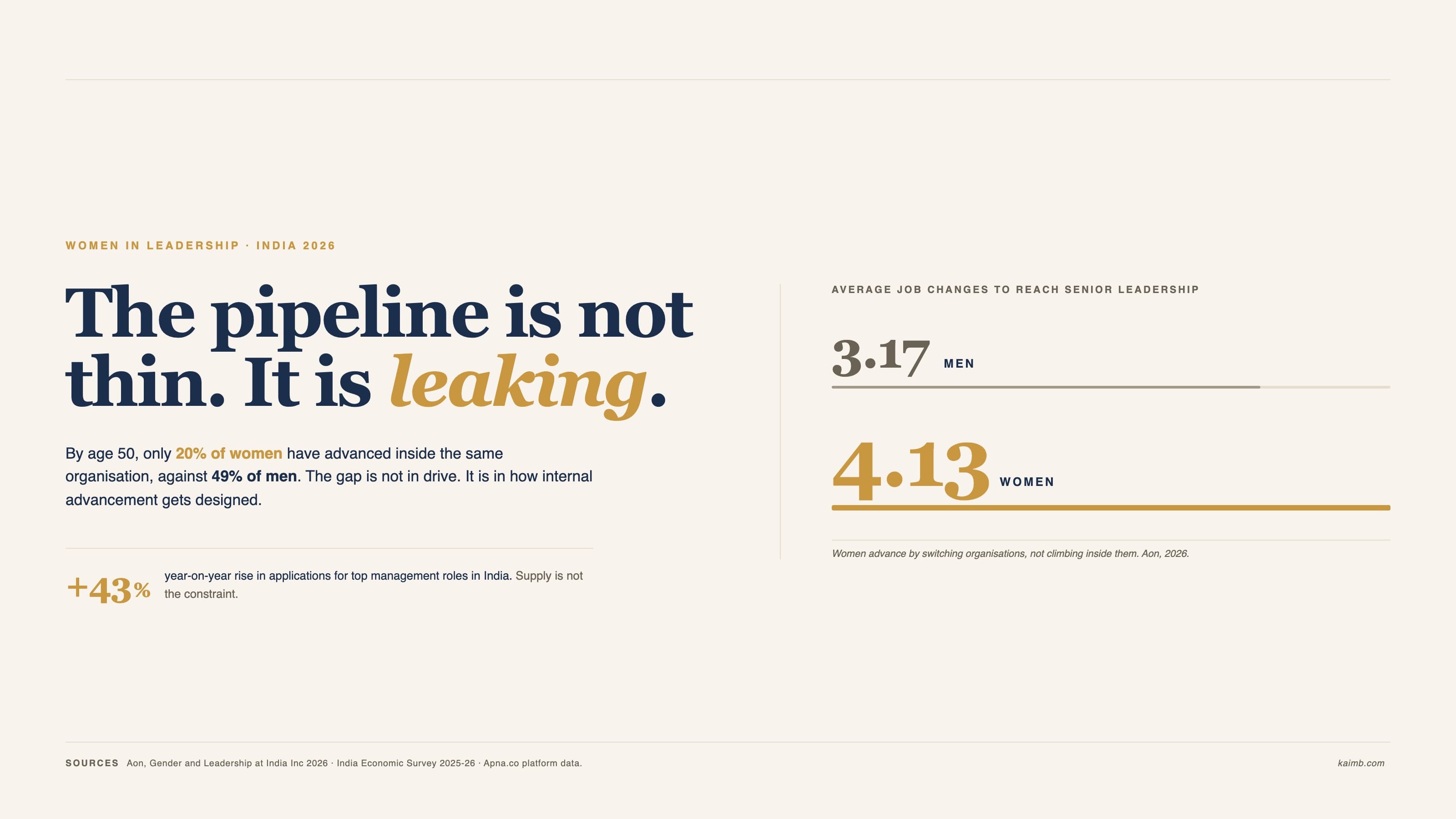
A March 2026 Aon study of 1,500 leaders across 30+ Indian cities found that by age 50, only 20% of women had advanced within the same organisation, versus 49% of men. Women average 4.13 career transitions to reach senior leadership; men average 3.17. The gap is not in drive. It is in how internal advancement systems are built.
Applications for top management roles in India rose 43% year-on-year, according to Apna.co's 2025-26 platform data. The supply of capable women is not the constraint. The constraint is what happens once they are inside.
What the 2026 Data Shows About Women in Leadership in India
The Aon "Gender and Leadership at India Inc" study surveyed 1,500 leaders — including 400+ women — across 30 cities in March 2026. Its findings document the structural shape of the problem with unusual precision.
Women and men enter leadership pipelines with comparable ambition and career drivers. That equivalence does not hold as careers progress. By 50, the advancement gap is 29 percentage points: 49% of men have moved up within the same organisation; only 20% of women have.
The mechanism is visible in where women are placed. 49% of women leaders sit in enabling functions (HR, finance, marketing) versus 37% of men — not because women chose support roles, but because that is where they were directed. Enabling functions have longer paths to the P&L experience most boards treat as the prerequisite for the CXO leap. The result shows up at the very top: only 9 of the top 500 companies have a woman CEO.
The perception gap compounds this. 84% of men believe advancement decisions at their organisation are unbiased. 65% of women do. That 19-point gap is not disagreement. It is two groups experiencing the same system differently.
The Caregiving Gap and What India's Policy Direction Acknowledges
India's Economic Survey 2025-26 named flexible work as the primary macroeconomic lever for increasing female labour force participation — targeting 55% FLFPR by 2050 from 41.7% in 2023-24. The reasoning is grounded in a specific disparity: women in India spend 363 minutes per day on unpaid caregiving and domestic work. Men spend 123. A 3x gap.
The government's position is that workplace design — not women's behaviour — is the variable that determines whether India reaches its growth targets. Leadership development programmes for women that ignore this context are solving at the wrong level.
The Paternity and Parental Benefit Bill 2025, introduced in Lok Sabha, proposes eight weeks paternity leave alongside eight weeks of shared parental leave for couples to divide within 18 months of birth. The framing matters: caregiving is not a women's issue. It is a family infrastructure issue, and the policy direction treats it that way.
What You Can Do
If you are a woman in mid-to-senior management
The 4.13 versus 3.17 transition figure is the most actionable data point here. Women are advancing — but through external moves rather than internal ones. If your organisation's internal advancement criteria are opaque, making them explicit is your first strategic task. Ask your sponsor directly: "What would I need to demonstrate to be the internal candidate for the next role up?" Force the unwritten rules into writing.
If you are a manager or people leader
Audit where women on your team sit. Are they concentrated in enabling functions? Is that by their choice or by default placement? The 43% surge in applications for senior roles means the pipeline is not thin. The question is where it is leaking. It is worth remembering that India's women now lead the world in AI skills, so the talent entering that pipeline is genuinely world-class. And where women's progression actually stalls is the manager layer, which is where the highest-leverage fix sits.
If you are a CHRO
The Economic Survey's framing is the right one. Transparent advancement criteria, flexible work, and caregiving infrastructure are not diversity programmes. They are talent efficiency measures. The organisations building this now are not ahead of the social curve. They are ahead of the legislative one.
How kaimb Helps
Women in leadership in India are not lacking ambition or capability. What is often missing is a clear, data-driven picture of where their leadership strengths actually sit — independent of the informal networks and enabling-function placement patterns that currently shape advancement decisions.
kaimb's leadership assessment gives women professionals a structured, competency-based read of their strengths: where they are genuinely strong, where there are real development gaps, and what the evidence says versus what informal reputation suggests. That is where evidence-based leadership development for women starts. Start with the assessment.
Frequently Asked Questions
Related reading
Does this resonate with your experience? We welcome your perspective.
Get in touch