kaimb Founders ·
The Leadership Skills That Actually Get Women Promoted
Summary
Women consistently outperform men on nearly every leadership skill that organizations say they value. The research is clear, the data is consistent — and the promotion gap still has not closed.
The problem is not the skills. It is the gap between which leadership traits get you rated high and which ones get you promoted. Those two things are not the same.
Here is what the research actually shows, and what mid-career women can do about it.
What the Data Shows About Women's Leadership Skills
Let's start with the number that should have changed everything.
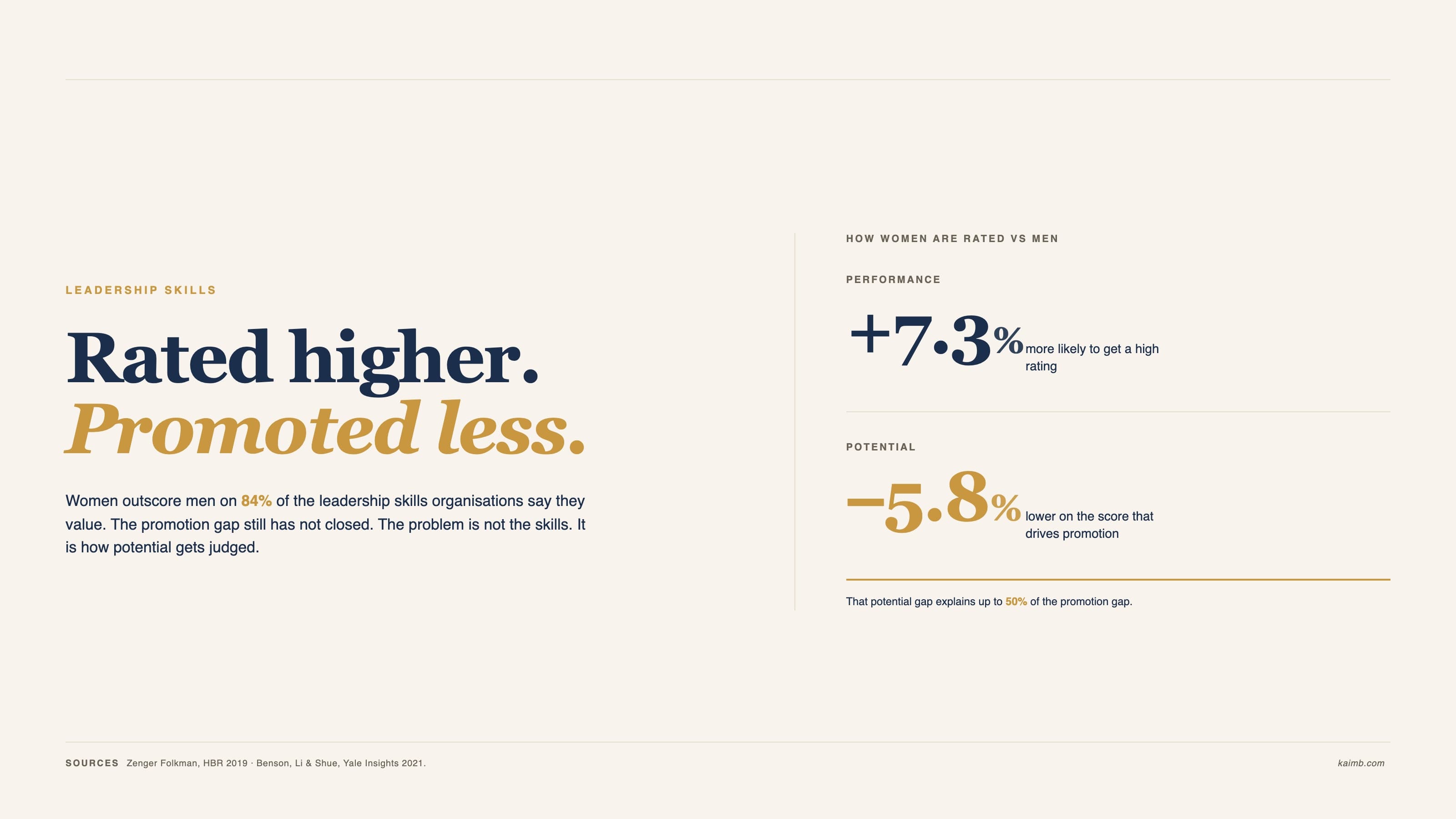
A large-scale analysis of 360-degree assessments found that women's leadership skills outrank men's in 84% of the competencies that leadership development consultancy Zenger Folkman most frequently measures. Not a few areas. Most of them.
The competencies where women led: taking initiative, driving results, displaying integrity, developing others, inspiring and motivating, building relationships, and championing change. These are not soft skills. These are the capabilities organizations say they need at the top.
Men outscored women on two: develops strategic perspective and technical or professional expertise. Both are areas where access, not aptitude, creates the gap. Men have historically had more exposure to the boardroom conversations and high-stakes decisions that build strategic fluency.
The data is consistent across years of research. Women's leadership skills are not the problem.
The Gap That Actually Drives Promotion Decisions
Here's where it gets important.
A study by researchers from Yale, MIT, and the University of Minnesota tracked nearly 30,000 workers at a large retail organization and found something that explains the disconnect precisely. Women were 7.3% more likely to receive high performance ratings. But their potential ratings were 5.8% lower. And those lower potential ratings explained up to 50% of the promotion gap.
Excellent work. Low potential. That is the gap.
Performance and potential are evaluated differently. Performance is backward-looking: what you did, what you delivered. Potential is forward-looking: where decision-makers imagine you going. And potential judgments are where subjective bias has the most room to run.
The leadership traits associated with management potential, including assertiveness, charisma, and strategic vision, are also traits stereotypically associated with male leaders. When evaluators picture someone who could lead this organization, that mental image matters more than they would admit.
This is not an individual skills problem. It is a design gap: the criteria for ready for the next level are doing different work for different people.
What Your Leadership Style Needs to Signal
This does not mean the skills do not matter. It means which skills you make visible, and to whom, changes everything.
The leadership traits that drive performance ratings — reliable delivery, developing your team, driving results — are table stakes. They get you rated. They do not get you promoted on their own.
What moves potential scores is strategic visibility: being seen operating at a level above your current role before you are asked to.
Operate at the edge of your current role
The clearest signal of readiness is already acting above your level, in meetings, in decisions, in the problems you choose to engage with. Do not wait to be given the scope. Create it.
Connect your work to the business explicitly
"I drove this result" matters less than "I drove this result because I saw where the market was moving." Strategic framing of your own contributions is a leadership skill. Practice it in how you write updates and present results.
Build a sponsor, not just a mentor
A mentor advises you. A sponsor advocates for you when you are not in the room. The research on women's advancement consistently points to sponsorship, not mentorship, as the structural lever. Who is making the case for your potential when decisions happen?
These are not personality adjustments. They are specific, learnable behaviors. They change how your leadership style gets read without requiring you to become someone else.
How kaimb Helps
One of the hardest parts of this is that most women do not have clear data on where their leadership strengths actually land. They receive performance feedback. They rarely receive a structured read of how their leadership capabilities compare to what the next level actually requires.
kaimb's assessment gives you that clarity. Not a personality type. A leadership strengths profile, benchmarked against what senior roles demand, so you can see exactly where you stand and what to develop without guessing. If you are mid-career and starting to wonder why the promotion conversations are not moving, start with the assessment, or read our full guide on women in leadership in India.
Frequently Asked Questions
Related reading
Does this resonate with your experience? We welcome your perspective.
Get in touch