kaimb Founders ·
Women CEOs in India: Why the Board Quota Wasn't Enough
Summary
India's board quota worked. The Companies Act, 2013 requirement that every listed company have at least one woman director lifted women to nearly a third of all director seats nationally. But the quota filled board seats. It never designed the path to the top.
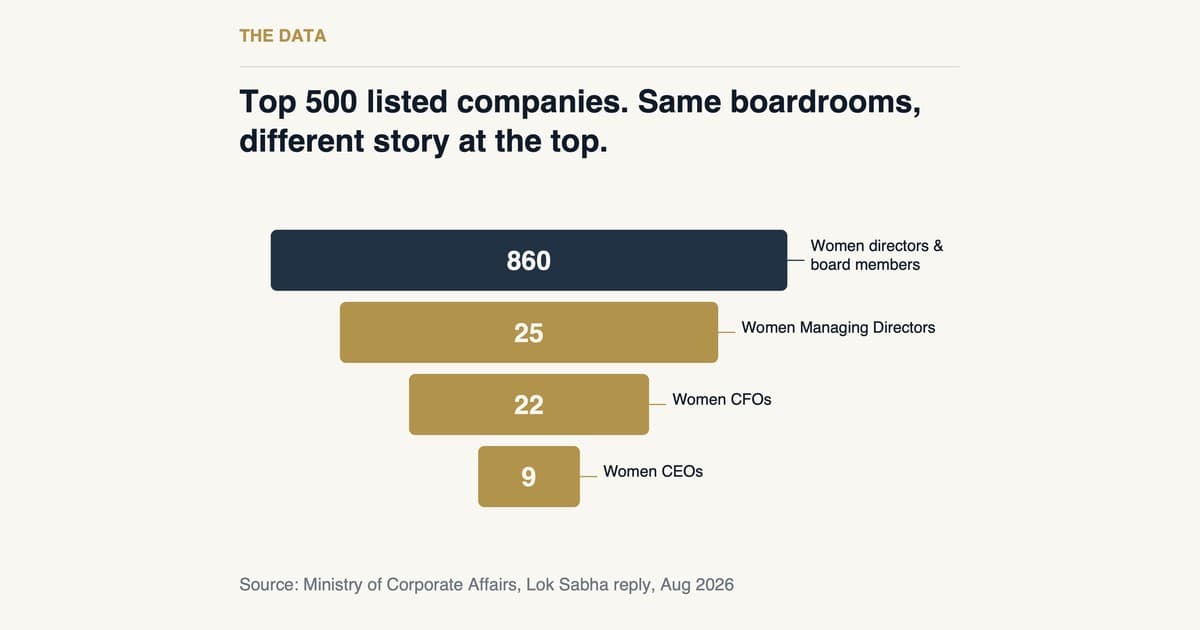
Across India's top 500 listed companies, 860 women sit as directors and board members. Just 25 are Managing Directors, 22 are CFOs, and 9 are CEOs. Representation at scale, absence at the top. The same system produces both. (Source: Ministry of Corporate Affairs, Lok Sabha reply, Aug 2026.)
The mechanism is structural, not personal. Quotas fill board seats; they do not build the P&L ownership and succession readiness that lead to CEO or MD. And no one has studied where women actually plateau, which means companies cannot fix a gap they have never measured.
Sponsorship is one lever that demonstrably works, and women get 16 points less of it at entry level: 45% of men have a sponsor, only 31% of women do. Finding the other levers requires structured diagnosis, not more pledges. (Source: LeanIn.Org and McKinsey, Women in the Workplace 2025.)
Why are there so few women CEOs in India?
The answer lives in a single government dataset. In August 2026, the Ministry of Corporate Affairs tabled a reply in the Lok Sabha with figures on women in leadership across India's top 500 listed companies. The funnel it revealed is stark.
860 women serve as directors and board members across those 500 boardrooms. Move to operating roles and the numbers collapse: 25 women Managing Directors, 22 women CFOs, 9 women CEOs.
The same boardrooms. Completely different outcomes depending on whether the role is a governance seat or an operating one.
This is the design gap in India Inc.'s leadership pipeline. The quota guaranteed a seat at the table. It was never designed to guarantee a seat at the head of the company. Those require different things: P&L accountability, revenue ownership, succession decisions. The quota touched none of them.
The women CEOs in India question, then, points to the middle of the pipeline: the operating roles that were never built as a path to the top.
What did India's board gender quota actually change?
Quite a lot, at one level. The Companies Act mandate, introduced in 2013, required every listed company to have at least one woman director. Nationally, women now hold nearly 30% of all director seats. That is a great shift, and it happened fast.
At the top 500, the picture is different. Women hold approximately 1.8% of CEO roles. The 2026 data on women in leadership in India shows this divergence clearly: representation mandated at the board level, near-absence in the roles that lead there.
The quota was a floor on governance representation. It was not a pipeline. The companies that treat board-level numbers as a proxy for leadership health are measuring the wrong thing.
Why do women plateau at director level?
Because director seats and CEO paths are built from different raw material.
A board seat typically requires industry credibility, external relationships, and governance expertise. A CEO path requires years of P&L ownership, operational decision-making, and active succession planning by the people above you. The quota addressed the first. Nobody addressed the second.
There is a second problem, equally serious. Per the same MCA government data, no study has examined where women drop off in the progression from director to MD to CEO. Companies do not know whether women are being overlooked at the succession conversation, exiting before they reach it, or simply never being given the operating roles that build the readiness for it.
The gap is not a mystery. It is unmeasured. And what is not measured does not get fixed.
What actually moves women into CXO roles?
Sponsorship is one lever with a strong evidence base. LeanIn.Org and McKinsey's Women in the Workplace 2025 found that 45% of men at entry level have a sponsor compared to 31% of women, a 16-point gap. Employees with sponsors are promoted at nearly twice the rate of those without.
Sponsorship means someone with power using it on your behalf: putting your name forward in a room you are not in, advocating for you in a succession discussion, making sure you are on the shortlist for the operating role that builds your P&L track record.
The unequal distribution of sponsorship explains some of the gap. It does not explain all of it. The other levers remain largely unidentified, because the question of where deserving women actually drop off has not been systematically studied in India Inc.
That is the real gap: a measurement problem that compounds into a representation problem.
How kaimb helps
kaimb works on the pipeline itself, at the level of design. We diagnose the design gaps holding mid-career women back, and build structured programs that give managers the tools to support their teams through critical transitions.
For a woman navigating the director-to-operating-role gap, that means clarity on where her leadership profile is strong and where a specific stretch would build the readiness the CEO or MD path requires. For an organisation, it means moving from anecdotal succession conversations to evidence-based ones.
No woman should be left behind because the lever that could have moved her was never studied. Start with the assessment or DM Anu or Kaveri directly.
Frequently Asked Questions
Related reading
Does this resonate with your experience? We welcome your perspective.
Get in touch