Leadership Coaching in India: A Practical Guide
Leadership coaching in India covers everything from a single career conversation to a 12-month structured programme. The quality of the outcome depends on three things: the data used to diagnose what to work on, the coach's experience in context, and how specifically you arrive knowing what you need. This page explains how coaching works in India, who delivers it, and how to use kaimb assessment data to make the coaching work faster.
What is leadership coaching and how does it work in India?
Leadership coaching in India covers a wide range of formats and providers. At one end: a single conversation with a business leader turned consultant, focused on a career decision or transition. At the other: a structured 12-month engagement with formal assessments, multi-rater 360-degree leadership assessment diagnostics, and regular sessions commissioned by a company for a senior leader preparing for CXO-level responsibility.
The quality of the outcome depends on three things: the coach's experience and credentials, the data used to diagnose what to work on, and how genuinely engaged the candidate is in the process.
How it is typically delivered: The most common individual format is a bundled short programme — 6 to 12 weeks, one hour per week. Companies with structured leadership development programmes run longer retainer arrangements (12 months) with established vendors. Group and cohort formats run through institutional programmes such as those at IIM-K and CFI.
Who delivers leadership coaching in India: The International Coaching Federation (ICF) is the dominant certification body in India, alongside EMCC, AC, and the India Coaching Federation. ICF credentials run from entry level (ACC: 100 coaching hours) to intermediate (PCC: 500 hours, the typical tier working with senior managers and CXOs) to highest level (MCC: 2,500 hours). Many practitioners are experienced business leaders who have moved into consulting; their credential is their track record, not a certification. Scaled delivery is handled by established corporate vendors such as MantraCoach, Erickson India, and Coacharya.
What leadership coaching is not: Mentoring transfers experience from someone who has been where you want to go. Training installs skills through structured instruction. Therapy addresses psychological wellbeing. Leadership coaching focuses specifically on how you lead and navigate your organisation.
Who is leadership coaching for?
Leadership coaching is most useful at inflection points: a promotion that feels within reach, a role change that requires a different kind of presence, a career pivot that needs a clear read on where you stand and what to build next.
It is particularly relevant for mid-career professionals who have built strong careers on subject matter expertise and are now finding that leadership behaviour — how you navigate influence, stakeholders, and ambiguity — matters as much as technical skill. This shift typically surfaces at manager level and sharpens at every level above it. Understanding what executive presence actually requires in practice is often the first thing people need to get specific about.
Companies sponsor coaching as part of structured leadership development programmes, typically for senior managers preparing for director or CXO-level responsibility. Individual professionals also come to coaching without company support, at their own cost, when they have a specific goal and want to reach it faster with external input.
The biggest variable in how useful coaching turns out to be is not the coach. It is whether you arrive knowing specifically what you need to work on, or with a vague sense that something needs to change.
Most professionals move from "I know I have a gap" to "I need a coach" without stopping at the step in between: getting precise about what the gap actually is. That step is what determines whether coaching accelerates your development or adds an expensive loop to it.
How do you know what to work on before you start?
Most professionals skip a step. They go from "I know I have a gap" directly to "I need a coach" — bypassing the diagnostic work of knowing precisely what the gap is and what to practice to close it.
kaimb starts there.
kaimb assessments range from a 15-minute DIY self-assessment across 8 dimensions and 39 parameters to a 1–2 week multi-rater process drawing on your self-view, manager input, peer feedback, your LinkedIn profile, and past appraisals. The output maps exactly where your self-perception diverges from how others experience your leadership — and what that means for the goal you are working toward.
Most leadership programmes tell you to "build executive presence." kaimb tells you to raise your viewpoint assertively in the next QBR to get the alignment you need for the new project. One is a concept. The other is a Tuesday morning action.
The output of a kaimb assessment is not a report to read once. It is a practice plan: specific actions tied to your stated goal — a promotion, a role change, an increment — embedded in your actual work week via kaimb Pathways.
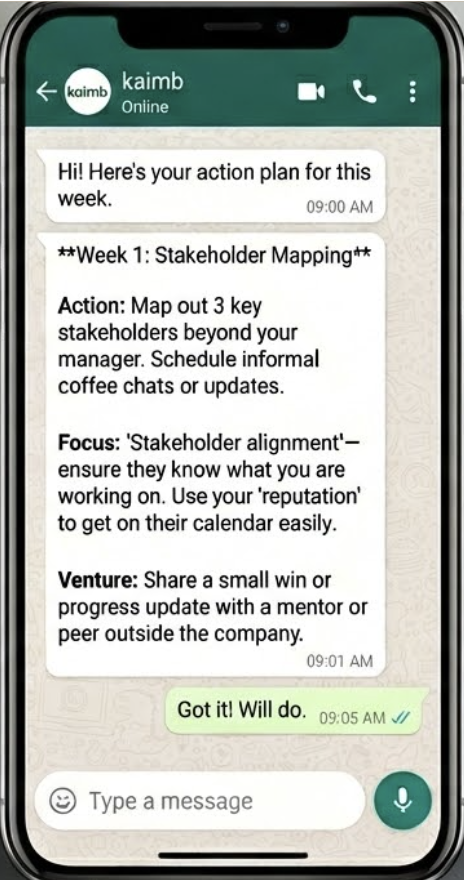
kaimb Pathways is the accountability layer. Each week, a WhatsApp intervention with a specific action grounded in your assessment data. Each week, a check-in on what is working. Each month, a review of whether the pathway needs adjusting. Here is what that looks like:
Week 1: Stakeholder Mapping — Map 3 key stakeholders beyond your manager. Schedule informal coffee chats or updates. Ensure they know what you are working on. Use your reputation to get on their calendar easily.
When deeper unblocking is needed — a root cause that requires excavation, a mental model that will not shift on its own — kaimb gets you to that conversation with a precise brief rather than a vague one. The assessment surfaces the picture. The founder conversations interpret it. Pathways embeds the practice.
Start with a 15-minute self-assessment: kaimb 360° Lite — ₹999. DM founders@kaimb.com for a free access code.
kaimb Pathways enquiries: DM founders@kaimb.com
How is kaimb different from traditional coaching?
kaimb and traditional coaching are two different tools for two different jobs — not competitors. Most professionals benefit from both at different points. The table below describes where each is built to operate.
| kaimb | Traditional Coaching | |
|---|---|---|
| Goal | Career Velocity & Outcomes (Promotions, Pivots, Influence) | Self-Discovery (Awareness, Reflection) |
| Approach | Data-Driven & Semi-Directive (We tell you what the data says) | Exploratory & Socratic (They ask you what you think) |
| Context | Hyper-Customised Playbook (Tailored to your specific ecosystem) | Universal Principles (Generic frameworks for all contexts) |
| Method | Pattern-Matched Insights (Based on what works for professionals like you) | Individual Wisdom (Relying on the coach's personal experience) |
| Focus | Finding the Tactic for a Design Challenge (Navigating politics, perception, power) | Fixing the Mindset (Internal beliefs and blocks) |
"Design Challenge" refers to the structural dynamics in your specific organisation — your manager relationship, your stakeholder map, the informal criteria your company uses to evaluate leadership readiness. Generic frameworks that do not know your ecosystem cannot address them. kaimb does.